
When Screenshots Enter the Courtroom
This article has been researched and written by Advocate Aarun Chanda, who practices divorce law in Mumbai and Pune. It is intended solely for academic purposes and should not be construed as legal advice. The views expressed are personal. Readers are encouraged to consult a qualified lawyer or advocate specializing in divorce cases for professional legal guidance.
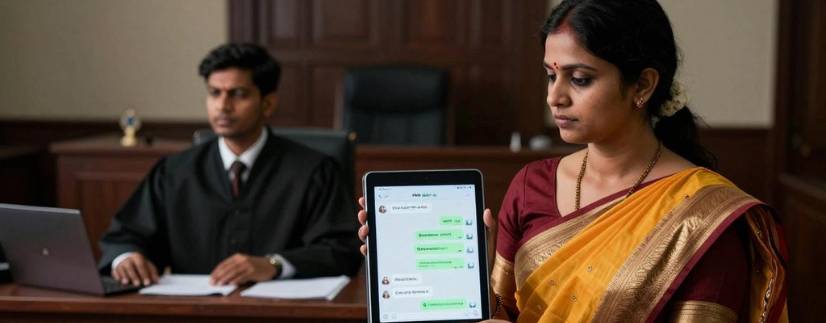
There is a particular ritual that plays out in my chamber almost every week now, and it never fails to make me feel simultaneously very modern and very old. A client walks in, sits down, and instead of opening with the marriage certificate or the FIR copy, opens with their phone. “Sir, please see this Instagram story first,” they say, thumb already scrolling, the actual pleadings forgotten somewhere at the bottom of the bag. I have, over the years, been handed screenshots of WhatsApp chats mid-argument, Facebook photographs printed out and laminated like family heirlooms, and on one memorable occasion, a client’s entire case theory built around the fact that his wife had “liked” a college classmate’s gym selfie four times in one month. I did gently explain that Section 13 of the Hindu Marriage Act has never, to my knowledge, recognised the double-tap as an instrument of cruelty. But I no longer laugh these clients out of my chamber the way I might have a decade ago, because somewhere between then and now, social media stopped being background noise in matrimonial litigation and became one of its principal instruments.
A family court in Jaipur gave us a rather vivid illustration of exactly how far this has gone, in an order passed this April.
1. THE CASE THAT MADE THE POINT
The petitioner-husband, married for eleven years, sought a divorce on the ground of mental cruelty. His central grievance was not a single dramatic betrayal but an accumulation of conduct that, taken together, had chipped away at what the court called his dignity and social standing. Among the evidence he placed before the court were photographs his wife had shared on social media, showing her with another man in a manner the court found went well beyond what it described as “the manners of normal relations.” The court held that displaying such closeness publicly on social media was not merely indiscreet — it fell squarely within the category of cruelty, observing that content shared on social media carries a public impact and that individuals are expected to act responsibly when they put their lives on display for an audience.
The judgment did not stop there. The court also took note of allegations that the wife used abusive language toward the husband and pressured him to live separately from his parents, treating this as further evidence of mental harassment. And in a detail that any practising lawyer will recognise as the kind of small, damning fact that quietly wins cases, it emerged that the wife had appeared for a government recruitment examination — for the post of patwari — declaring herself unmarried, filling in her official forms as though the husband simply did not exist. Weighing all of this cumulatively, the court concluded that maintaining a relationship with another individual beyond ordinary limits, and broadcasting it on social media, amounted to matrimonial misconduct — in the court’s own phrase, “an act amounting to an insult to the marital relationship” — and granted the divorce.
I want to be precise about what this order actually did, because the headlines it generated were, predictably, breathless. The court did not hold that having a male friend, or being photographed with one, is inherently cruel. It held that the specific conduct before it — the nature of the photographs, combined with the abusive behaviour, the pressure to abandon his parents, and the striking dishonesty in an official document — cumulatively crossed the threshold that the law has long recognised for mental cruelty. Social media was not the whole case. It was the exhibit that made the rest of the case impossible to argue away.
2. WHERE THIS SITS IN THE LAW OF CRUELTY
None of this required inventing new law. Section 13(1)(ia) of the Hindu Marriage Act, 1955 has permitted divorce on the ground of cruelty for decades, and our courts have consistently held — as the Supreme Court reiterated in Samar Ghosh v. Jaya Ghosh — that mental cruelty cannot be reduced to a rigid checklist. It has to be assessed cumulatively, from the totality of one spouse’s conduct upon the other, judged against the backdrop of their particular life, temperament, and social milieu. What the Jaipur order does, in effect, is apply that decades-old, flexible standard to a form of conduct that simply did not exist when the standard was first articulated. A public Instagram post is a new fact pattern; it is not a new legal test. The court asked the same old question — does this conduct, viewed as a whole, make it impossible for the other spouse to continue living with dignity in the marriage — and found, on these facts, that the answer was yes.
3. THE HARDER QUESTION: GETTING THE SCREENSHOT INTO EVIDENCE
Here is where I have to gently disappoint every client who arrives at my chamber convinced that a screenshot, by itself, wins the case. It does not. It has to survive the evidentiary gate first, and that gate has become considerably more particular than most people imagine.
For years, the law on electronic evidence in India ran through Section 65B of the Indian Evidence Act, 1872, which required a certificate confirming the authenticity and origin of any electronic record before a court could rely on it, rather than the original device itself. The Supreme Court, in Anvar P.V. v. P.K. Basheer, made this certificate mandatory for secondary electronic evidence — a screenshot, a printout, a forwarded chat — and there followed a period of genuine confusion about whether that requirement could be relaxed where a party simply did not possess the original device. The Court finally settled the matter in Arjun Panditrao Khotkar v. Kailash Kushanrao Gorantyal, holding that the certificate remains mandatory, but that a party who does not control the device may apply to the court to direct the person who does to produce it or furnish the certificate.
That entire framework now travels under a new name. Since the 1st of July 2024, the Bharatiya Sakshya Adhiniyam, 2023 has replaced the old Evidence Act, and Section 63 of the BSA has taken over the role once played by Section 65B, with one meaningful addition: the certificate must now be signed both by the person in charge of the device and by an independent expert, and must record the record’s hash value, a digital fingerprint meant to guard against tampering. The old case law on 65B continues to guide how courts read this new provision, but the practical lesson for litigants has only sharpened with time — a screenshot pulled off a phone and printed at the local Xerox shop, however damning it looks, is not evidence until it is properly certified. I have watched otherwise strong matrimonial cases wobble in cross-examination not because the underlying conduct was in doubt, but because nobody thought to get the certificate right before the trial began.
4. A DOUBLE-EDGED SWORD, WIELDED BY BOTH SIDES
What makes this area of practice genuinely interesting — and, if I am honest, genuinely a little unsettling is that social media cuts both ways with equal enthusiasm. I have used a husband’s own public boasting on Facebook to establish his income for a maintenance claim, after he had sworn an affidavit of comparative poverty before the Family Court. I have seen Facebook photographs relied upon in other courts to support allegations of an extramarital relationship, and WhatsApp messages accepted as direct evidence of verbal cruelty and abuse, exactly the way any diary entry or letter might once have been. Cyberstalking and online harassment between estranged spouses have, in parallel proceedings, drawn the attention of courts entirely apart from the matrimonial case itself, underscoring that a phone is no longer merely a communication device in a failing marriage — it is a running, contemporaneous record of the marriage’s failure, written by both parties without either quite realising they were building a case file in real time.
This is, I think, the real transformation worth naming. Cruelty used to be proved retrospectively, through memory, through witnesses straining to recall who said what during a quarrel three years ago. Social media has turned marital conduct into something closer to a live transcript — dated, timestamped, and, crucially, difficult to walk back once it has been posted for an audience of friends, family, and, eventually, a judge.
5. A WORD OF CAUTION, FROM THE OTHER SIDE OF THE TABLE
I would be doing my profession a disservice if I let this article read as an uncomplicated celebration of digital surveillance dressed up as evidence law. The same ease with which a genuine screenshot can prove cruelty is the same ease with which a fabricated one can manufacture it. Doctored images, messages taken wildly out of context, and accounts compromised without consent — Section 72A of the Information Technology Act criminalises the unlawful interception of another person’s private communications, and a spouse who hacks into the other’s phone to manufacture ammunition may find themselves defending a criminal complaint of their own before their matrimonial petition is even heard. The certificate requirement under Section 63 of the BSA exists precisely to slow this process down — to insist that before a court treats a screenshot as truth, someone stands behind its authenticity and puts their name to it.
6. A CLOSING THOUGHT ON DIGNITY IN THE AGE OF THE TIMELINE
I find myself returning, again and again in this line of work, to a fairly old-fashioned idea dressed in new clothes: that marriage, whatever else it is, remains a relationship of mutual dignity, and that dignity does not disappear simply because the parties involved now live a substantial part of their lives on a screen. The Jaipur court’s order is a reminder that the law has not needed to reinvent itself to keep pace with Instagram and WhatsApp — it has simply had to recognise that the same conduct which would once have wounded a marriage in private now frequently does so in public, with an audience, a timestamp, and a permanence that a heated argument in the privacy of one’s own home never had.
That, ultimately, is what the rule of law is meant to do in moments like this — not chase technology for its own sake, but hold its ground on an old and simple principle, and insist that the principle still applies even when the evidence now arrives as a PNG file instead of a love letter. A phone cannot make or break a marriage. But it can, increasingly, make or break the case that follows one — and every spouse walking into a matrimonial dispute today would do well to remember that their own timeline may one day be Exhibit A.
Seeking expert legal guidance?- Contact The Divorce Law Firm today.